Category: Poetry

This Week’s Dragon: Glitter

When the Gods tried to divide the light

from the darkness, the light scattered

and fled into shimmering fragments.

Mica, Hematite

Malachite

Each spark dimmed to hide

from the Gods with their cleavers,

their scissors, their claws.

Emerald, Jade,

Peridot

Each followed the darkness

into the soil and burrowed,

becoming one with the Earth.

Diamond, Citrine,

Amethyst

The light intertwined with the darkness,

the darkness intertwined with the light,

giving birth to shimmering veins.

Garnet, Aquamarine,

Moonstone

The veins swirled around metallic ores

feeding them with their brilliance,

embracing the shadows in a maze.

Ruby, Opal,

Turquoise

Serpentine, the veins grew muscular

arms and legs, thick tails, star tipped

claws, throbbing necks, star dust eyes.

Obsidian, Fused quartz,

Limestone

Alive, the dragons rose

shedding glistening scales

onto the sun kissed surface.

you’re

LOVED

uncondishinally

Some are caught in dew drops

in the filaments of fur and feather

in the sweat of hair less apes.

Silica, Iron,

Titanium

Some scales were harvested

into vials to be pour onto the head

of the adult child, child adult

you’re

LOVED

uncondishinally

where they will intertwine

with her black rose root curls

singing glistening the words

you’re

LOVED

uncondishinally

you’re

LOVED

uncondishinally

you’re

LOVED

uncondishinally

THE STREET

Tenderloin

The following is the October 2012 draft of The Street. I dedicate this poem to all who walk the streets. Peace be with you.

Once upon a time, there was the Street,
pavement speckled pebble sharp,
that stretched from one end of the country to the other.

The Congressmen, The Clergy, and the Citizens knew him well
and often walked upon him.
One day, the Street found a Crack-head’s baby sitting in the gutter.
The Street had an idea.
He would raise the baby.

“Who will help me raise the Crack-head’s baby?” asked the Street.

“Not I,” announced the Congressmen.
“Not I,” spat the Clergy.
“Not I,” stuttered the Citizens.

“Then I will,” said the Street. So, the Street raised the baby, all by himself.

When the baby had grown into a child, the Street asked the people,
“Who will help me teach this child?”

“Not I,” proclaimed the Congressmen.
“Not I,” sang the Clergy.
“Not I,” mumbled the Citizens.

“Then I will,” said the Street. So, the Street taught the child, all by himself.

When the child finally bloomed into a woman, the Street asked the people,
“Who will help me protect this woman and help her find work?”

“Not I,” declared the Congressmen.
“Not I,” pronounced the Clergy.
“Not I,” muttered the Citizens.

“Then I will,” said the Street.
So, the Street protected the woman against the sewers,
the soil, and the subway cars, that lie beneath his surface. The Street brought the woman
to a dark alley with a single red light, all by himself, sent her through the door underneath the red light, and carried her heavy footsteps back to the gutter when she came out.

The Street asked the people, “Who will help me get this woman to a free clinic?”

“Not I,” stated the Congressmen.
“Not I,” prayed the Clergy.
“Not I,” stammered the Citizens.

“Then I will,” said the Street.
But all the free clinics were closed.

Nine month’s passed and the woman gave birth to a baby boy.
The woman died in child birth,
leaving the boy with the Street.

“Who will raise this boy?” asked the Street.

“Not I,” said the Congressmen.
“Not I,” said the Clergy.
“Not I,” said the Citizens.

“Then I will,” said the Street.

Creeping Silver

Vietnam Memorial

on two gabbro walls
reflective stones from India
cut and fabricated in Vermont
Tennessee etched the creeping silver

the creeping silver transposed
onto the black gash of shame
onto the mirror preserving our present
presence as marvelously precious

the creeping silver strands streak
across the faces of weeping widows
weeping widowers, weeping mothers
weeping fathers, weeping children

the creeping silver travels off the walls
visits every state in the nation,
every storefront, every front door
every living room, every crib

the creeping silver grows thicker
longer with each passing bullet
train each resounding report
chilling blood underneath blankets

the creeping silver hides in rubber
soles, in neon cathedrals,
in the finger tips holding this page
close to eyes reflecting creeping silver

Week28Year1 (1st Draft)

Raised Hands

I dedicate this poem to the victims, survivors, fighters, police, nurses, and all who helped in the aftermath of the Boston Marathon Bombing. This is for you.

After W.S. Merwin

Look,
with the first responders
we raise our hands.

From the front lines
we are reporting.

We are running out of
lock-down campuses
our mouths full of blood
to look at the falling Gods
and raise our hands.

We are diving into the Pacific
raising it, opening windows,
looking out at every compass point

back at a series of abandoned lots
back at jails after the novenas
we raise our hands
after the dead tweet
whether we knew them or not
we raise our hands.

In alleyways and in back roads
and in closets and in stairways
remembering wars, occupations, guns,
germs, and steel at the door
and the beatings on the back
we raise our hands.

In river banks,
we are raise our hands.
To the faces of officials and the 1%
we raise our hands
and to all who never change
we go on raising our hands.

For the children dying around us,
the lost years,
we raise our hands.

For the burning jungles
filling our lungs
we raise our hands

With limbs growing out
like poppy petals from pitch
roads, sprawling cancer sites,
along water ways
we are raising our hands
faster and faster

With nobody watching
we are raising our hands

We are raising our hands
and we are keeping the darkness
at bay.

Week18Year2

Week14Year1

I cannot write today
I cannot read
I can only sing
in off and on keys.

I cannot write today
I cannot read
I can only dance outside
on wobbly bowlegged knees

I cannot write today
I cannot read
I can only laugh out loud
while watching kitties sneeze

I cannot write today
I cannot read
I can only stroll along
enjoying the evening breeze

I cannot write today
I cannot read
I cannot be productive
in any capacity

I can sing
I can dance
I can stroll along
I can give  life a  chance

A chance to show
a chance to know
a chance to feel and to see
what all those books
were trying all those years
to tell me.

Week14Year1 WordPress Version

(c) Rose Booker

To the Only Once: Black Tea

A disposable cup
comprised of compressed cardstock
bleached in an acid dissolving solution
stamped with red ink.
Folded by mechanical limbs
guided by a computerized brain
designed by industry,
schooled in mathematical arts,
to hold 16 ounces of boiled water
only once.

Heat escapes
Energy runs out
Burns the hand that holds it.
Dress it up
cardboard sleeves
to shield the hands
only once.

Black tea,
harvested from Chinese fields
where camellia sinensis bloom
white petals golden centers,
dried in cold rooms,
welted sits blacken
inside a porous bag of plastic.
only once

Dip into boiling water
leaves bleed
through and into.
Their essence
leached from them
only once

When the cup runs empty
when the heat is gone
when the tea is colorless
then the cup is thrown
then the tea is thrown
then the heat is thrown
to the only once.

Week48Year1Version3

Found Poetry and Random Acts Of Inspiration

Hi all,

This week is spring break but I’m still writing (just not on days when I would have had a class . . . that was converted to sleep time).

I “finished” (as finished as a 1st draft can get) a new poem done in a form I’m not that use to yet. I basically wrote a Found Poem; a poem where the text does not originate from the poet. Instead, the text is found and then rearranged to bring about new meaning, context, clarity or what-have-you to the words themselves. Think of it as collage for poets who have having a hard time dealing with the deadly blank page.

The poem itself is tentatively called Golgotha. I recently was praying the rosary for friends, family, and Japan when I came across the word. For the life of me I had no idea why it mattered that Jesus is said to be crucified at Golgotha, nor did I know where the place was. So I hit the Wikipedia pages and found some text that was ripe for poetry. A bit of cutting here, some rearranging there, and vola! A new poem.

The poem is actually addressed to other believers in Christ who may not be in touch with Him in the way that counts. You see, over the last, oh say, 10 years anyone who believed in God has been lumped with extremist who believe that what is written is verbatim what God meant. However, this is not true.

Language is ever-changing, so how can the words that have been largely mistranslated from the get-go be the direct words of God?

Conversely, what is so amazing about language is that as it evolves (and is allowed it) the root meaning can still be gathered in some way.

Why does Golgotha lead to the skull?

What is the significance that Jesus died at a place called the skull?

Is it simply further Christian critics against inquiry or is it something more?

Why does it matter that Helen of Troy may or may not have named the place in the first place?

Why is Golgotha in reality flat like a plain but in the Bible round like a skull?

My poem begins to (very roughly) address these questions.

It is my belief that to believe blindly is to not believe at all. You must go through the valley of the shadow of doubt and come out of it with your faith intact after seeing all that this world has to offer through language, science, history, animals, plants, biospheres, and ultimately each other.

It is hard to be Christian in today’s world where the very history of Christian Warfare is attached to each King James translation. However, it is my hope that someday everyone will focus on the root that connects all beliefs and that is simply one large truth:

We humans need one another.

This need should be enough to begin to settle differences. I may be naive to believe this, but at the end of the day I at least have this hope, this faith.

And to all my non-Christian friends and loved-ones: that you for respecting my beliefs and helping me grow as a person. I could not have gone half as far without you.

Peace, love, and pancakes,

Rose


Poems, poems everywhere, but never enough ink.

Hi Everyone!

Got two new poems coming right at ya. Both are inspired by The Network by Jena Osman. It’s a fabulous book and I highly recommend it to anyone who has an open-mind and likes poetry of connections.

The first poem is directly inspired by her work and by Gargoyles.

Yes, these guys. I always wanted to write something related to them, but what came out was something unintentional. This poem is  very very rough so if you ever need an example of a bad first draft here it is:

Gargoyle

The next poem was more of a technique-based exercise combined with a theme I’ve been mulling over. Ever wonder if there is a right way to fail? Well, there is and I think this poem will explain what I mean.

Failing Better

Anyways, that’s it for this week’s poems. Please, as always, comment with critiques. Thanks.

Peace, love, and pancakes,

Rose

OFF-Day

Hi Everyone,

Today my class had off because Prof. C had to go to Maryland for a literary business trip (the best kind!). So, the class was told to dedicate the time we have off to writing. Truth be told a good portion of the time I used was for resting and relaxing but I soon kicked my little literary butt into gear.

Next week we have to recite two poems: one we wrote and one from an author we admire. My first choice for poems from other authors was Lewis Carroll’s Jabberwocky, simply because Jabberwocky is awesome to recite and to be able to at any given moment would be sweet.

HOWEVER, after I thought about it for a while and realized that for the type of poems I write and the more serious literature that make up the literary cannon, I decided on Emily Dickinson’s 712. It is a marvelous poem that demonstrates one way of envisioning death that is devious in its simplicity.

BUT, I do not like all work and no fun. So to balance off DEATH I wanted to add in something a bit lighter to my repertoire . Still serious in subject matter, but lighter in tone. So here is my second take on Plug in Plug out.

This one is for you Michael Jackson!

Is that all I did for class today?

HECK NO!

I liked Dickinson’s poem so much that I decided to use it as a template for a new poem. So here it is for the first time ever: Because!

As always, comments and critiques are welcome. Thanks for the help.

TTYL

-Rose


2 new poem drafts! (I’m on a semi-roll here!)

Hi everyone. Thanks for the feedback with the last poems. It always helps to have extra eyes look over your work and give you good advice (and to catch any un-intended grammatical mistakes).

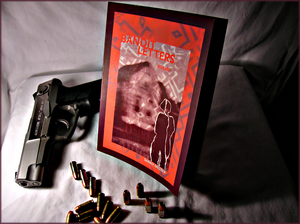
This week’s poems are both responses to works I’ve encountered recently either directly or indirectly through Prof. Dungy’s classes. The first one is in response to Sarah Messer’s Bandit Letters. I highly recommend reading this book if you are in any way interested in contemporary historical poetry set in the West. Her work is simply sublime!

My response poem tried to combine the south, steam punk and pirates (because pirates rock). Hope the poem does some just to Messer’s work.

You’ll be Rewarded Within a Month

The second poem is in response to Barbara Jane Reyes’s poem,“Where Did Your Mother Live?”

Prof. Dungy introduced me to Reyes’s work last year, recommending that I read her books because of my interest in Filipino-American poetry. Unfortunately, I haven’t yet read any of her books but I did get a chance, recently, to visit her site. She is a CAL alumni who graduated from SFSU with a MFA in creative writing and has published nervous books of poetry related to identity, the Filipino-American experience, and living in the SF Bay Area. In short, she is what I aspire to be! Her poetry also hits home for me, as a mixed American with Filipino roots. I borrowed heavily from here in this next piece, especially where form is concerned. However, I tired to vary the theme through the type of repetition (instead of “in” I use “the,” because my emphasis is on identity as apposed to place) and images I used. Hopefully I was able to capture the same kind of emotion. I’ll let you be the judge:

What are you

Hope you enjoy the poems. As always feel free to comment and critique.

Thanks a bunch.

-Rose